

[2023] Use Valid PAS-C01 Exam - Actual Exam Question & Answer
Test Engine to Practice PAS-C01 Test Questions
NEW QUESTION # 13
A company is migrating its SAP workloads to AWS The company's IT team installs a highly available SAP
S.4HANA system that uses the SAP HANA system replication cluster package on SUSE Linux Enterprise Server The IT team deploys the system by using cluster nodes m different Availability Zones within the same AWS Region.
After the initial launch of the SAP application the application is accessible However after failover the IT team cannot access the application even though the system is up and running on the secondary node After investigation an SAP solutions architect discovers that the virtual IP address has not been used correctly Which combination of steps should the SAP solutions architect take to resolve this problem? (Select TWO.)
- A. Choose an overlay IP address within the VPC CIDR block that corresponds with the primary node of the cluster
- B. Use an overlay IP address as a secondary IP address with the primary node of the cluster
- C. Choose an overlay IP address within the VPC CiDR block that corresponds with the secondary node of the cluster
- D. Use an overlay IP address as a virtual IP address
- E. Choose an overlay IP address outside the VPC CiDR block that hosts the application and the database
Answer: A,B
NEW QUESTION # 14
A company wants 10 run SAP HANA on AWS m the eu-centrai-1 Region. The company must make the SAP HANA system highly available by using SAP HANA system replication in addition the company must create a disaster recovery (DR) solution that uses SAP HANA system replication in the eu-west-1 Region As prerequisites the company has confirmed that inter-AZ latency is less than 1 ms and that Inter-Region latency is greater than 1 ms.
Which solutions will meet these requirements? (Select TWO.)
- A. Install the tier 1 primary system and the tier 2 secondary system in eu-central-1 Configure the tier 1 system m Availability Zone 1 Configure the tier 2 system m Availability Zone 2 Configure SAP HANA system replication between tier 1 and tier 2 by using ASYNC replication mode install the OR tier 3 secondary system m eu-west-1 by using SYNC replication mode.
- B. Install the tier 1 primary system and the tier 2 secondary system in eu-central-1 Configure the tier 1 system m Availability Zone 1 Configure the tier 2 system m Availability Zone 2 Configure SAP HANA system replication between tier 1 and tier 2 by using SYNCMEM replication mode Install the DR tier 3 secondary system in eu-west-1 by using ASYNC replication mode
- C. Install the tier 1 primary system and the tier 2 secondary system in eu-central-1 Configure the tier 1 system in Availability Zone 1 Configure the tier 2 system in Availability Zone 2 Configure SAP HANA system replication between tier 1 and tier 2 by using SYNC replication mode Install the OR tier 3 secondary system n eu-west-1 Store daily backups from tier 1 m an Amazon S3 bucket m eu-central-1 Use S3 Cross-Region Replication to copy the daily backups to eu-west-i where they can be restored if needed
- D. install the tier 1 primary system in eu-central-1 install the tier 2 secondary system and the DR tier 3 secondary system m eu-west-1 Configure the tier 2 system in Availability Zone 1 Configure the tier 3 system in Availability Zone 2 Configure SAP HANA system replication between all tiers by using ASYNC replication mode
- E. Install the tier 1 primary system and the tier 2 secondary system in eu-central-1 Configure the tier 1 system in Availability Zone 1 Configure the tier 2 system m Availability Zone 2 Configure SAP HANA system replication between tier 1 and tier 2 by using SYNC replication mode Install the OR her 3 secondary system n eu-west-1 by using ASYNC replication mode.
Answer: C,E
NEW QUESTION # 15
A company is running an SAP HANA database on AWS The company is running AWS Backint Agent for SAP HANA(AWS Backint agent) on an Amazon EC2 instance AWS Back agent is configured to back up to an Amazon S3 bucket The backups are failing with an AccessDeniod error m the AWS Backint agent log file.
What should an SAP basis administrator do to resolve this error?
- A. Assign execute permissions at the operating system level for the AWS Backint agent binary and for AWS Backint agent
- B. Assign the correct Region ID for the S3BucketAwsRegion parameter in AWS Backint agent for the SAP HANA configuration file
- C. Assign the value for the Enable Tagging parameter in AWS Backint agent for the SAP HANA configuration file
- D. Assign an 1AM role to an EC2 instance Attach a policy to the IAM role to grant access to the target S3 bucket
Answer: C
NEW QUESTION # 16
A company wants to improve the RPO and RTO for its SAP disaster recovery (DR) solution by running the DR solution on AWS The company is running SAP ERP Central Component (SAP ECO on SAP HANA The company has set an RPO of 15 minutes and an RTO of 4 hours.
The production SAP HANA database is running on a physical appliance that has x86 architecture. The appliance has 1 TB of memory and the SAP HANA global allocation limit is set to 768 GB. The SAP application servers are running as VMs on VMware and they store data on an NFS file system The company does not want to change any existing SAP HANA parameters that are related to data and log backup for its on-premises systems.
What should an SAP solutions architect do to meet the DR objectives MOST cost-effectively?
- A. For the SAP HANA database change the log backup frequency to 5 minutes Move the data and log backups to Amazon S3 by using AWS Storage Gateway File Gateway For the SAP application servers export the VMs as AMIs by using the VM Import'Export feature from AWS For NFS file shares
/sapmnt and 'usr saplrans establish realtime synchronization from AWS DataSync to Amazon Elastic Foe System (Amazon EFS) - B. For the SAP HANA database SAP application servers and NFS Me shares use CloudEndure Disaster Recovery to replicate the data continuously from on premises to AWS Use CloudEndure Disaster Recovery to launch target instances in the event of a disaster
- C. For the SAP HANA database use a smaller SAP certified Amazon EC2 instance Use SAP HANA system replication with ASYNC replication mode to replicate the data continuously from on premises to AWS For the SAP application servers use CloudEndure Disaster Recovery for continuous data replication For NFS file shares sapmnt and .'uv-sap'trans. establish real-time synchronization from AWS DataSync to Amazon Elastic File System (Amazon EFS)
- D. For the SAP HANA database change the log backup frequency to 5 minutes Move the data and log backups to Amazon S3 by using the AWS CLI or AWS DataSync Launch the SAP HANA database For the SAP application servers, export the VMs as AMis by using the VM import/Export feature from AWS For NFS file shares/sapmnt and usr-sap/trans/ establish real-time synchronization from DataSync to Amazon Elastic File System (Amazon EFS)
Answer: C
NEW QUESTION # 17
A company's SAP basis team is responsible for database backups in Amazon S3. The company frequently needs to restore the last 3 months of backups into the pre-production SAP system to perform tests and analyze performance. Previously an employee accidentally deleted backup files from the S3 bucket. The SAP basis team wants to prevent accidental deletion of backup files in the future.
Which solution will meet these requirements?
- A. Enable versioning and multi-factor authentication (MFA) on the S3 bucket
- B. Apply an S3 Lifecycle policy to move the backup fries immediately to S3 Glacier
- C. Create a new resource-based policy that prevents deletion of the S3 bucket
- D. Create signed cookies for the backup files in the S3 bucket Provide the signed cookies to authorized users only
Answer: A
Explanation:
Explanation
enabling versioning and multi-factor authentication (MFA) on the S3 bucket. Versioning will allow you to keep multiple versions of your backup files in the same bucket, so you won't have to worry about accidental deletion. Multi-factor authentication (MFA) will help ensure that only authorized users can access or delete the backup files.
NEW QUESTION # 18
A company uses an SAP application that runs batch jobs that ate performance sensitive. The batch jobs can be restarted safely The SAP application has sot application servers. The SAP application functions reliability as long as the SAP application availability remains greater than 60%. The company wants to migrate the SAP application to AWS. The company is using a duster with two Availability Zones How should the company distribute the SAP application servers to maintain system reliability?
- A. Distribute the SAP application servers equally across three Availability Zones
- B. Create an Amazon EC2 Auto Scaling group across two Availability Zones Set a minimum capacity value of 4.
- C. Distribute the SAP application servers equally across two Availability Zones
- D. Distribute the SAP application servers equally across three partition placement groups
Answer: A
NEW QUESTION # 19
A company is running SAP on anyDB at a remote location that has slow and inconsistent internet connectivity.
The company wants to migrate its system to AWS and wants to convert its database to SAP HANA during this process Because of the inconsistent internet connection the company has not established connectivity between the remote location and the company's VPC in the AWS Cloud.
How should the company perform this migration?
- A. Migrate by using SAP HANA system replication over the internet connection Specify a public IP address on the target system
- B. Migrate by using SAP Software Update Manager (SUM) Database Migration Option (DMO) with System Move Use an AWS Snowball Edge Storage Optimized device to transfer the SAP export files to AWS
- C. Migrate by using SAP HANA system replication with initialization through backup and restore Use an AWS Snowball Edge Storage Optimized device to transfer the SAP export files to AWS
- D. Migrate by using SAP Software Update Manager (SUM) Database Migration Option (DMO) with System Move Use Amazon Elastic File System (Amazon EPS) to transfer the SAP export files to AWS
Answer: B
Explanation:
Explanation
Snowball Edge allows for offline data transfer, which is suitable for cases where there is slow and inconsistent internet connectivity. The data can be transferred to the Snowball Edge device, shipped to the AWS region, and then imported into the new SAP HANA system in the VPC. This is a suitable option for migrating large amounts of data from a remote location to AWS.
NEW QUESTION # 20
A company is planning to migrate its on-premises SAP application to AWS. The application runs on VMware vSphere The SAP ERP Central Component (SAP ECC) server runs on an IBM Db2 database that is 2 TB m size The company wants to migrate the database to SAP HANA Which migration strategy will meet these requirements'?
- A. Use AWS Server Migration Service (AWS SMS)
- B. Use AWS Database Migration Service (AWS DMS)
- C. Use AWS Application Migration Service (CloudEndure Migration)
- D. Use SAP Software Update Manager (SUM) Database Migration Option (DMO) with System Move
Answer: D
NEW QUESTION # 21
A company needs to migrate its critical SAP workloads from an on-premises data center to AWS The company has a few source production databases that are 10 TB or more in size The company wants to minimize the downtime for this migration As part of the proof of concept the company used a low-speed high-latency connection between its data center and AWS During the actual migration the company wants to maintain a consistent connection that delivers high bandwidth and low latency. The company also wants to add a layer of connectivity resiliency. The backup connectivity does not need to be as fast as the primary connectivity An SAP solutions architect needs to determine the optimal network configuration for data transfer. The solution must transfer the data with minimum latency Which configuration will meet these requirements?
- A. Set up Amazon Elastic fie System (Amazon EPS) file system storage between the on-premises data center and AWS Configure a cron job to copy the data into this EFS mount Access the data in the EFS file system from the target environment
- B. Set up two redundant AWS Site-to-Site VPN connections for connectivity between the on-premises data center and AWS
- C. Set up one AWS Direct Connect connection for connectivity between the on-premises data center and AWS Add an AWS Site-to-Site VPN connection as a backup to the Direct Connect connection
- D. Set up an AWS Direct Connect gateway with multiple Direct Connect connections that use a link aggregation group (LAG) between the on-premises data center and AWS
Answer: D
NEW QUESTION # 22
A company has an SAP Business One system that runs on SUSE Linux Enterprise Server 12 SP3. The company wants to migrate the system to AWS An SAP solutions architect selects a homogeneous migration strategy that uses AWS Application Migration Service (CloudEndure Migration) After the server migration process is finished the SAP solutions architect launches an Amazon EC2 test instance from the R5 instance family. After a few minutes the EC2 console reports that the test instance has failed an instance status check Network connections to the instance are refused How can the SAP solutions architect solve this problem?
- A. Reboot the instance to initiate instance migration to another host
- B. Request an instance limit increase for the AWS Region where the test instance is being launched
- C. Create a ticket for AWS Support that documents the test server instance ID Wait for AWS to update the host of the R5 instance
- D. Install the missing drivers on the source system Wait for the completion of migration synchronization Launch the test instance again
Answer: C
NEW QUESTION # 23
An SAP basis architect is configuring high availability for a critical SAP system on AWS. The SAP basis architect is using an overlay IP address to route traffic to the subnets across multiple Availability Zones within an AWS Region for the system's SAP HANA database.
What should the SAP basis architect do to route the traffic to the Amazon EC2 instance of the active SAP HANA database?
- A. Edit the network ACL of the subnet that includes the EC2 instance that runs SAP HANA Allow traffic for SAP HANA specific ports from the overlay IP address
- B. Edit the inbound and outbound rules in the security group of the EC2 instance that runs SAP HANA Allow traffic for SAP HANA specific ports from the overlay IP address
- C. Edit the route in the route table of the VPC that includes the EC2 instance that runs SAP HANA Specify the overlay IP address as the destination Specify the private IP address of the EC2 instance as the target
- D. Edit the route in the route table of the VPC that includes the EC2 instance that runs SAP HANA Specify the overlay IP address as the destination Specify the elastic network interface of the EC2 instance as the target
Answer: D
NEW QUESTION # 24
A company wants to migrate its SAP workloads to AWS from another cloud provider. The company's landscape consists of SAP S 4HANA SAP BWMHANA SAP Solution Manager and SAP Web Dispatcher SAP Solution Manager 15 running on SAP NANA The company wants 10 change the operating system from SUSE Linux Enterprise Server to Red Hat Enterprise Linux as a pan of this migration. The company needs a solution that results in the least possible downtime for the SAP SMHANA and SAP BW 4HANA systems.
Which migration solution will meet these requirements?
- A. Use backup and restore for SAP S'4 HAN A and SAP BW 4HANA Use SAP Software Provisioning Manager to perform a system export import for SAP Solution Manager Reinstall SAP Web Dispatcher on AWS with the necessary configuration.
- B. Use SAP HANA system replication to replicate the data between the source system and the target AWS system for SAP S 4HANA and SAP BW 4HANA Use SAP Software Provisioning Manager to perform a system export import for SAP Solution Manager Reinstall SAP Web Dispatcher on AWS with the necessary configuration
- C. Use backup and restore tor SAP S'4HANA. SAP BW4HANA and SAP Solution Manager Reinstall SAP Web Dispatcher on AWS with the necessary configuration
- D. Use SAP Software Provisioning Manager to perform a system export/import for SAP S/4HANA SAP BW.4HANA SAP Solution Manager and SAP Web Dispatcher
Answer: B
NEW QUESTION # 25
A company has an SAP environment that runs on AWS. The company wants to enhance security by restricting Amazon EC2 Instance Metadata Service (IMDS) to IMDSv2 only. The company's current configuration option supports both iMDSvi and iM0Sv2. The security enhancement must not create an SAP outage.
What should the company do before it applies the security enhancement on EC2 instances that are running the SAP environment?
- A. Ensure that the EC2 instances are Nitro based
- B. Stop the EC2 instances
- C. Ensure that the AWS Data Provider for SAP is installed on each EC2 instance
- D. Ensure that the SAP kernel versions are 7.45 or later
Answer: D
Explanation:
Explanation
Ensure that the SAP kernel versions are 7.45 or later. This is important because IMDSv2 is only supported by SAP kernel versions 7.45 and later. If the SAP kernel versions are not at least 7.45, then the enhancement will cause an SAP outage as the instances will not be able to communicate with the metadata service.
NEW QUESTION # 26
A company's basis administrator is planning to deploy SAP on AWS m Linux. The basis administrator must set up the proper storage to store SAP HANAdata and log volumes. Which storage options should the basis administrator choose to meet these requirements? (Select TWO.)
- A. Amazon Elastic File System (Amazon EFS>
- B. Amazon S3
- C. Amazon Elastic Block Store (Amazon EBS) Throughput Optimized HDD (st1)
- D. Amazon Elastic Block Store (Amazon EBS) Provisioned IOPS SSD (io1, k>2)
- E. Amazon Elastic Block Store (Amazon EBS) General Purpose SSD (gp2 gp3)
Answer: A,B
NEW QUESTION # 27
A company has deployed SAP workloads on AWS The AWS Data Provider for SAP is installed on the Amazon EC2 instance where the SAP application is running An SAP solutions architect has attached an IAM role to the EC2 instance with the following policy.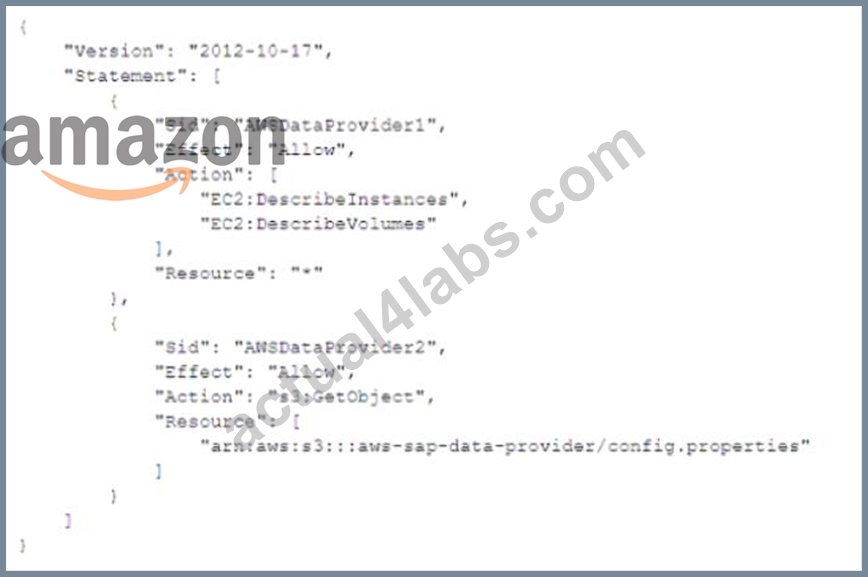
The AWS Data Provider for SAP is not returning any metrics to the SAP application. Which change should the SAP solutions architect make to the 1AM permissions to resolve this issued.
- A. Add the cloudwatch GetMetricStream action (o the policy statement with Sid AWSDataProvider
- B. Add the cloudwatch ListMetrics action to the policy statement with Sid AWSDataProvider1.
- C. Add the cloudwatch DescribeAlarmsForMetric action to the policy statement with Sid AWSDataProvider
- D. Add the cloudwatch GetMetricStatrstics action to the policy statement with Sid AWSDataProvider1
Answer: B
NEW QUESTION # 28
A company wants to deploy an SAP HANA database on AWS by using AWS Launch Wizard for SAP An SAP solutions architect needs to run a custom post-deployment script on the Amazon EC2 instance that Launch Wizard provisions.
Which actions can the SAP solutions architect take to provide the post-deployment script m the Launch Wizard console? (Select TWO.)
- A. Provide the FTP URL of the script
- B. Provide the Amazon S3 URL of the script
- C. Upload the script
- D. Write the script inline
- E. Provide the HTTPS URL of the script on a web server
Answer: C,E
Explanation:
Explanation
The SAP solutions architect can provide the post-deployment script on the Launch Wizard console by either providing the HTTPS URL of the script on a web server or uploading the script.
Providing the FTP URL of the script is not a valid option as it's an insecure protocol and it's not recommended to use it. Providing the Amazon S3 URL of the script is not a valid option as it's a storage service and it's not designed to run scripts. Writing the script inline is not a valid option as it's not a scalable solution and it would be harder to maintain the scripts.
NEW QUESTION # 29
A company wants to improve the RPO and RTO for its SAP disaster recovery (DR) solution by running the DR solution on AWS The company is running SAP ERP Central Component (SAP ECO on SAP HANA The company has set an RPO of 15 minutes and an RTO of 4 hours.
The production SAP HANA database is running on a physical appliance that has x86 architecture. The appliance has 1 TB of memory and the SAP HANA global allocation limit is set to 768 GB. The SAP application servers are running as VMs on VMware and they store data on an NFS file system The company does not want to change any existing SAP HANA parameters that are related to data and log backup for its on-premises systems.
What should an SAP solutions architect do to meet the DR objectives MOST cost-effectively?
- A. For the SAP HANA database change the log backup frequency to 5 minutes Move the data and log backups to Amazon S3 by using AWS Storage Gateway File Gateway For the SAP application servers export the VMs as AMIs by using the VM Import'Export feature from AWS For NFS file shares /sapmnt and 'usr saplrans establish realtime synchronization from AWS DataSync to Amazon Elastic Foe System (Amazon EFS)
- B. For the SAP HANA database use a smaller SAP certified Amazon EC2 instance Use SAP HANA system replication with ASYNC replication mode to replicate the data continuously from on premises to AWS For the SAP application servers use CloudEndure Disaster Recovery for continuous data replication For NFS file shares sapmnt and .'uv-sap'trans. establish real-time synchronization from AWS DataSync to Amazon Elastic File System (Amazon EFS)
- C. For the SAP HANA database SAP application servers and NFS Me shares use CloudEndure Disaster Recovery to replicate the data continuously from on premises to AWS Use CloudEndure Disaster Recovery to launch target instances in the event of a disaster
- D. For the SAP HANA database change the log backup frequency to 5 minutes Move the data and log backups to Amazon S3 by using the AWS CLI or AWS DataSync Launch the SAP HANA database For the SAP application servers, export the VMs as AMis by using the VM import/Export feature from AWS For NFS file shares/sapmnt and usr-sap/trans/ establish real-time synchronization from DataSync to Amazon Elastic File System (Amazon EFS)
Answer: A
NEW QUESTION # 30
A company is starting a new project to implement an SAP landscape with multiple accounts that belong to multiple teams in the us-east-2 Region. These teams include procurement finance sales and human resources An SAP solutions architect has started designing this new landscape and the AWS account structures The company wants to use automation as much as possible The company also wants to secure the environment implement federated access to accounts centralize logging and establish cross-account security audits in addition the company's management team needs to receive a top-level summary of policies that are applied to the AWS accounts.
What should the SAP solutions architect do to meet these requirements?
- A. Use AWS CloudFormation StackSets to apply SCPs to multiple accounts in multiple Regions. Use an Amazon CloudWatch dashboard to check the applied policies in the accounts
- B. Use an AWS Elastic Beanstalk blue green deployment to create 1AM policies and apply them to multiple accounts together Use an Amazon CloudWatch dashboard to check the applied policies in the accounts
- C. Implement guardrails by using AWS CodeDeploy and AWS CodePipeline to deploy SCPs into each account Use the CodePipeline deployment dashboard to check the applied policies in the accounts
- D. Apply SCPs through AWS Control Tower Use the AWS Control Tower integrated dashboard to check the applied policies in the accounts
Answer: D
Explanation:
Explanation
AWS Control Tower is a service that automates the set up of a secure, compliant, multi-account AWS environment. It helps to establish guardrails and automate the deployment of security policies to multiple accounts in a centralized and consistent manner. By using AWS Control Tower, the SAP solutions architect can establish guardrails across all accounts, set up federated access, centralize logging, and establish cross-account security audits. The integrated dashboard in AWS Control Tower allows the management team to receive a top-level summary of policies that are applied to the AWS accounts. This will help the company to meet their requirements of using automation as much as possible, securing the environment and implementing federated access to accounts, centralizing logging and establishing cross-account security audits.
NEW QUESTION # 31
A company is planning to move to AWS. The company wants to set up sandbox and test environments on AWS to perform proofs of concept (POCs) Development and production environments will remain on premises until the POCs are completed.
At the company's on-premises location SAProuter is installed on the same server as SAP Solution Manager. The company uses SAP Solution Manager to monitor the entire landscape The company uses SAP router to connect to SAP Support The on-premises SAP Solution Manager instance must monitor the performance and server metrics of the newly created POC systems on AWS. The existing SAP router must be able to report any issues to SAP What should an SAP solutions architect do to set up this hybrid infrastructure MOST cost-effectively''
- A. Install a new SAP Solution Manager instance and a new SAP router instance m the AWS environment Connect the POC systems to these new instances Use these new instances m parallel with the on-premises SAP Solution Manager instance and the on-premises SAP router instance
- B. Add the POC systems on AWS to the existing SAP Transport Management System that is configured m the on-premises SAP systems
- C. Use AWS Site-to-Site VPN to connect the on-premises network to the AWS environment Connect the POC systems on AWS to the on-premises SAP Solution Manager instance and the on-premises SAP router instance
- D. Install a new SAP Solution Manager instance and a new SAP router instance in the AWS environment install the Amazon CloudWatch agent on all on-premises instances Push the monitoring data to the new SAP Solution Manager instance Connect ail on-premises systems and POC systems on AWS to the new SAP Solution Manager instance and the new SAP router instance Remove the on-premises SAP Solution Manager instance and the on-premises SAP router instance Use the new instances on AWS
Answer: C
NEW QUESTION # 32
A company is running an SAP on Oracle system on IBM Power architecture in an on-premises data center.
The company wants to migrate the SAP system to AWS. The Oracle database is 15 TB n size The company has set up a 100 Gbps AWS Direct Connect connection to AWS from the on-premises data center.
Which solution should the company use to migrate the SAP system MOST quickly?
- A. Before the migration window build a new installation of the SAP system on AWS by using SAP Software Provisioning Manager Back up the Oracle database by using native Oracle tools Copy the backup of the Oracle database to AWS through the Direct Connect connection Import the Oracle database to me SAP system on AWS Configure Oracle Data Guard to begin replication on-premises database log changes from the SAP system to the new AWS system During the migration window use Oracle to replicate any remaining changes to the Oracle database hosted on AWS Switch over to the SAP system on AWS
- B. Before the migration window build a new installation of the SAP system on AWS by using SAP Software Provisioning Manager. During the migration window export a copy of the SAP system and database by using the heterogeneous system copy process and R3load Copy the output of the SAP system files to AWS through the Direct Connect connection import the SAP system to the new SAP installation on AWS Switch over to the SAP system on AWS
- C. Before the migration window launch an appropriately sized Amazon EC2 instance on AWS to receive the migrated SAP database Create an AWS Server Migration Service (AWS SMS) job to take regular snapshots of the on-premises Oracle hosts Use AWS SMS to copy the snapshot as an AMI to AWS through the Direct Connect connection Create a new SAP on Oracle system by using the migrated AMI During the migration window take a final incremental SMS snapshot and copy the snapshot to AWS Restart the SAP system by using the new up-to-date AMI Switch over to the SAP system on AWS
- D. Before the migration window build a new installation of the SAP system on AWS by using SAP Software Provisioning Manager Create a staging Oracle database on premises to perform Cross Platform Transportable Tablespace (XTTS) conversion on the Oracle database Take a backup of the convened staging database Copy the converted backup to AWS through the Direct Connect connection import the Oracle database backup to the SAP system on AWS Take regularly scheduled incremental backups and XTTS conversions of the staging database Transfer these backups and conversions to the AWS target database During the migration window, perform a final incremental Oracle backup Convert the final Oracle backup by using XTTS Replay the logs in the target Oracle database hosted on AWS Switch over to the SAP system on AWS
Answer: C
NEW QUESTION # 33
......
PAS-C01 Actual Questions Answers PDF 100% Cover Real Exam Questions: https://passcollection.actual4labs.com/Amazon/PAS-C01-actual-exam-dumps.html